




Stitching Stories: Mia Hansson and Her Extraordinary Bayeux Tapestry Journey
Published on 01/06/2026
At Appletons Wool, we’re endlessly inspired by the creativity, passion and dedication of our stitching community, and few stories capture that spirit quite like Mia Hansson.
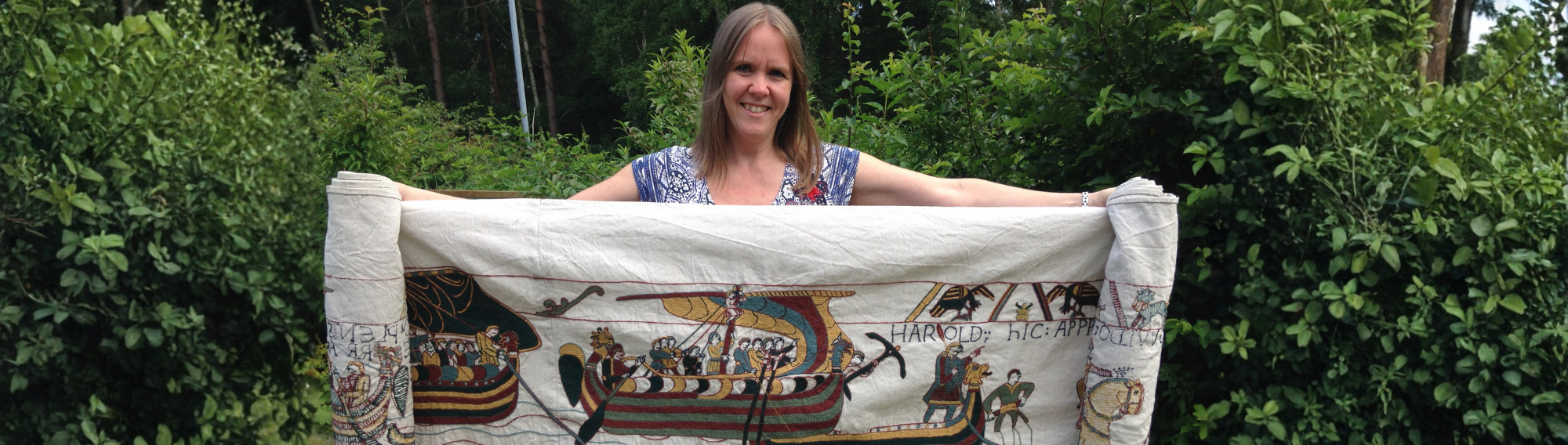
For nearly 10 years, Mia has been hand stitching a full-scale recreation of the famous Bayeux Tapestry using traditional techniques, incredible attention to detail and plenty of determination. What began as a way to cure boredom has evolved into a thriving, international online Bayeux Tapestry community led by Mia, bringing together more than 13,000 people who share a passion for stitching, history and craftsmanship.
We sat down with Mia to talk about how it all started, the challenges of recreating such an iconic piece, her upcoming book and why sometimes you simply have to finish what you started.
“I needed a project I couldn’t finish in a hurry”
Q: For those new to your work, how would you describe what you do and how it all began?
“It began because I was bored!
I used to make Viking reenactment clothing because my husband and I were involved in reenactments at the Battle of Hastings. You can’t really buy those clothes, so I hand stitched and embroidered everything myself.
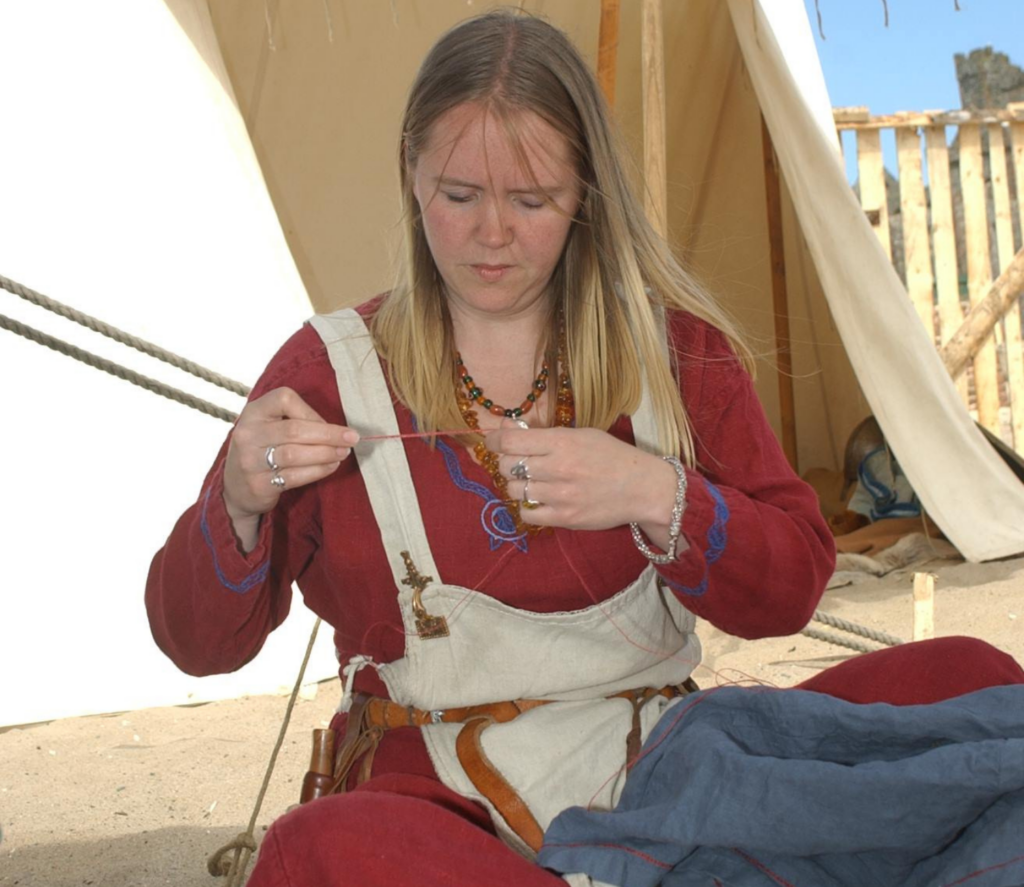
When the orders stopped coming in, I started making smaller projects including hats, hoods, bags, glove puppets, but I finished them too quickly. I needed something I couldn’t finish in a hurry.
And nothing is bigger than the Bayeux Tapestry.
I thought, ‘If I do that, I’ll be busy every single day for at least 10 years.’ So that’s exactly what I did.”
“If you’re going to do it, do it full scale”
Q: What first sparked your fascination with the Bayeux Tapestry?
“Honestly? At first, it was the size of it more than the history.
I’d heard about someone making a half-scale version and thought, ‘Well, if he can do that, I can do that.’ But to me, there’s no point doing it half scale. If you’re going to do it, you do it properly. Full scale, all of it.
I’d actually seen the original years earlier by accident. We took the wrong turn coming off the ferry in Calais and ended up nearby, so we thought it would be rude not to visit!
But what really appealed to me was how simple and striking the imagery is. I’m not naturally brilliant at drawing, so I needed something I could realistically recreate myself. The shapes are bold, the stitches are straightforward once you learn them and the whole thing just clicked for me.”
Nowadays, I study the original tapestry using the Bayeux Museum’s online panorama viewer, where you can zoom in and see every individual stitch in incredible detail. Before that, I mainly worked from David M. Wilson’s The Bayeux Tapestry book, which is now practically held together with tape from overuse!
If you want to explore the tapestry the same way I do, the Bayeux Museum has an amazing online viewer where you can scroll through the embroidery scene by scene and zoom right into the stitching details.”
You can explore it here: Bayeux Museum Online Panorama Viewer
Nearly 10 years in… and still stitching
Q: How long has the project taken?
“I started on the 13th of July 2016, so I’m coming up to 10 years now. And I still have about 10 metres left to stitch!
Originally I wanted to finish in 10 years, then 11 years… now I’m aiming for October 2027 to coincide with the millennium celebrations of William the Conqueror’s birth and the reopening of the Bayeux Museum after refurbishment.
But if I can finish in July 2027, that would be amazing because that’s when the original tapestry returns to France after its UK exhibition.”
“I honour the original embroiderers – mistakes and all”
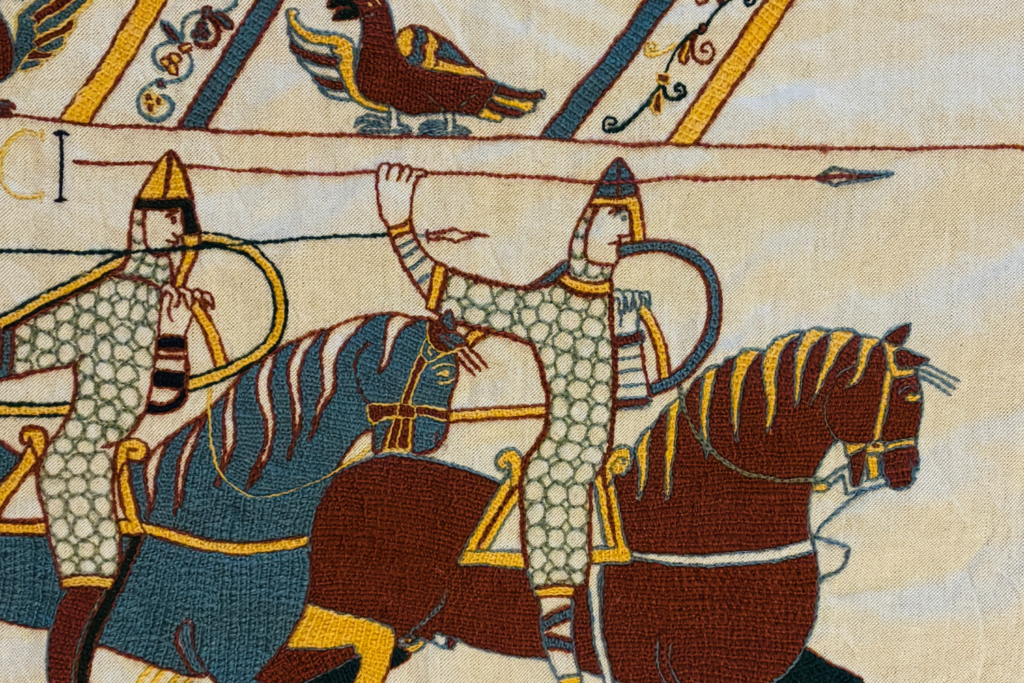
Q: Why is it important to stay true to traditional Bayeux techniques?
“If you’re going to do something like this, you have to do it right.
I want to honour the original embroiderers’ work, so I study the tapestry very closely. If there are mistakes in the original, I recreate those mistakes too – even though it drives me mad! For example, look at the men outside Harold’s coronation. Either the man in red has two left hands or the man in yellow has the wrong-coloured sleeve.
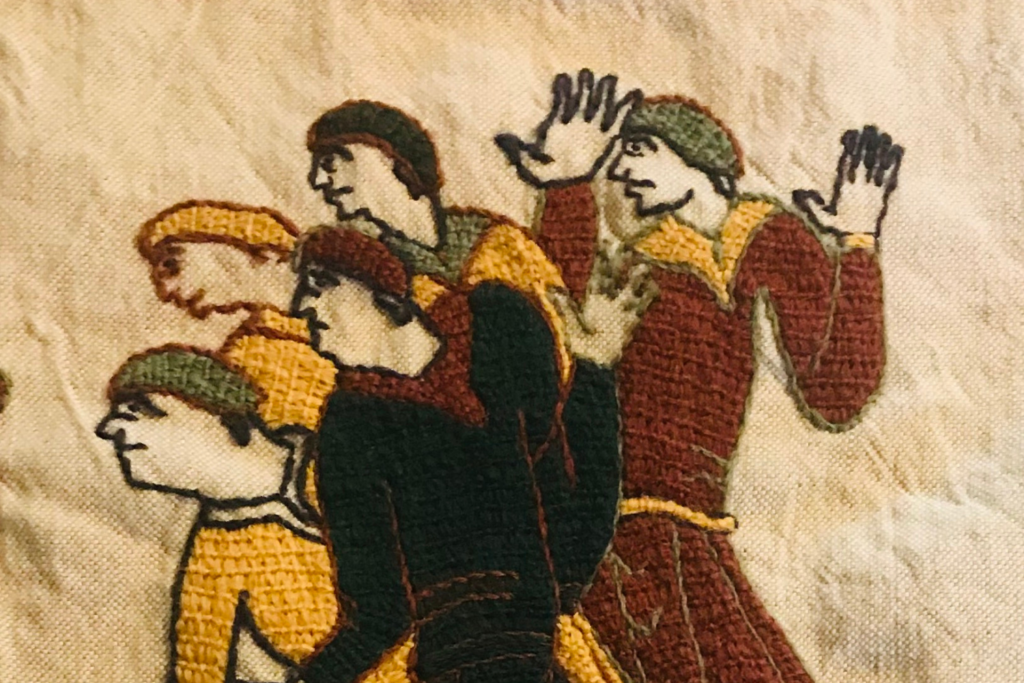
I also follow the original stitch directions wherever possible, even when I personally would have stitched it differently. I’m governed by their work.
It’s not an exact replica because I make my own mistakes too, but I want it to be as close as I can possibly make it.”
The materials: “It took me weeks to pick seven colours”
Q: Tell us about your creative process and choosing materials.
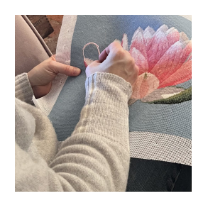
“I don’t use a frame, so the linen had to be strong enough to support the weight of the embroidery without bunching or scrunching up while I stitched.
The fabric I eventually chose is around 400gsm because anything lighter just didn’t hold the wool properly. I later tried several batches around 300gsm and they were too soft, no matter how careful I was with my stitching.
I went to around 15 fabric shops on Goldhawk Road in London literally touching and testing fabric until I finally found the right one.
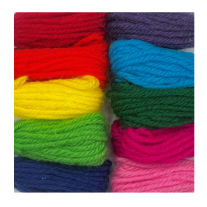
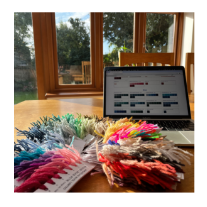
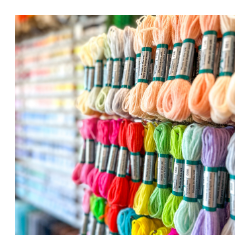
Choosing the wool colours took even longer. I used an Appletons shade card alongside David M. Wilson’s Bayeux Tapestry book to colour match the original. At the time there were around 413 shades available and I only needed seven colours, so I thought it would be easy. It absolutely wasn’t. Every page of the book looked slightly different depending on lighting and photography.
In the end, I chose colours based on how I believe the tapestry would have looked when it was brand new, rather than how it appears faded today. I use two blues, two greens, a dark turquoise, red and yellow. Some people believe there were 10 colours originally, but I think many of the shades came from variations in dyeing techniques rather than entirely different colours.”
Mia also shared one of her early lessons learned when selecting wool:
“I tell people, don’t be me! I bought Appletons four-ply wool and split it myself thinking I was saving money and getting twice as much for my money. Years later I discovered Appletons sell their wool by weight, so financially I wasn’t gaining anything at all!
But by then I couldn’t change it because my homemade version was slightly thicker than the original two-ply, and it would have shown in the stitching. So now I always tell people, if you want thick, lush stitching then go for it, but if you want to save money… don’t be me!”
Everyday life, puppies and stitching therapy
Q: How does everyday life influence your pace and creativity?
“At the moment, I can only stitch when the puppy sleeps!
He’s a German Wirehaired Pointer and he’s absolutely everywhere. The other day he stole my wool bag and ran around the garden with the balls of wool flying everywhere.
Before him, I could stitch for three or four hours at a time. Now I’m lucky if I get half an hour.
I’m also a full-time carer for my stepson Tom, who has severe disabilities, so stitching becomes my quiet space. It’s therapy in a way. Caring full time isn’t always easy and having this project there in the background keeps me happy.”
“You can’t stop now”
Q: What keeps you motivated during such a huge project?
“If you start eating a liquorice shoelace, you don’t eat half and put the rest away forever.
You finish it.
That’s exactly how I feel about the tapestry now. Once you’ve committed to something this enormous, it becomes part of your life. I’ve spent nearly 10 years with this project beside me every single day. It’s been there through family life, caring responsibilities, house renovations, puppies causing chaos – everything.
In the beginning, you probably could walk away from a project like this. But once you’ve stitched this much of it, stopping simply isn’t an option. I’ve invested too much time, energy and emotion into it.
And honestly, I don’t want to become ‘the woman who didn’t finish’. I’m far too stubborn for that!
There’s also something incredibly satisfying about seeing it slowly grow section by section. Even after all this time, I still get excited watching scenes come together and noticing tiny details in the original tapestry that I hadn’t spotted before. It still surprises me, which keeps it interesting.”
Advice for beginner stitchers
Q: What advice would you give someone inspired to start stitching?
“I really recommend trying Bayeux-style embroidery because it’s surprisingly forgiving and beginner friendly. People often assume it must be incredibly complicated, but the actual stitches themselves are very simple once you get used to them.
That’s part of the beauty of it. You don’t need to be an expert embroiderer to start. There are smaller sections, border animals, birds and decorative details that are perfect for beginners, and because the style is quite organic, it doesn’t have to look perfect to look beautiful.
But the biggest piece of advice I’d give anyone is to decide very early on what kind of project you want this to be for you.
Do you want to recreate the tapestry exactly as it exists today, including all the original quirks, oddities and mistakes, or do you want to create your own interpretation inspired by it?
That decision changes everything.
Mia’s upcoming book
Q: Tell us about your new pattern book.
“Oh my goodness, it’s one of the prettiest books I’ve ever held. The cover actually feels like fabric and the inside is beautiful. The photography is incredible and it’s written exactly how I speak. Very conversational, very ‘me’.
There are 25 full-scale patterns included, ranging from simple border creatures to large detailed scenes like Harold between the relics and William meeting Harold.
Each project includes stitching guidance, colour suggestions and the Appletons wool shade references I used.”
The book, Embroider the Bayeux Tapestry, also explores Mia’s fascinating theories about the original embroiderers:
“In some scenes, I genuinely believe you can see different embroiderers’ personalities through the stitching styles.
There’s one ship scene where I think four different people worked on it. One embroiderer stitched elaborate decorative ropes with yellow chain stitch, while another used only simple red stem stitch.
And there’s one poor man on the tapestry with absolutely no facial features at all. I always joke that the embroiderer must have argued with her husband that morning!”
Looking ahead: talks, collaborations and “super-secret” projects
Q: What’s next for you?
“I’ve started doing live talks and events again because I love speaking to people face to face about the tapestry.
I’ve also got a new colouring book coming out later this year and I’m working on what I call ‘the missing piece’, my own interpretation of the lost ending of the Bayeux Tapestry.
And then there’s a super-secret project launching in September… we’ve already done the filming and photography for it, but I’m still sworn to secrecy for now!”
“If it comes to the UK, I’ll be first in line”
Q: How do you feel about the Bayeux Tapestry coming to the UK?
“I’m incredibly excited.
I’d always planned to travel back to Bayeux to see the tapestry again after the museum refurbishment, but now it’s potentially coming to London instead.
Part of me thinks it’s too precious to move, it’s the handling rather than the travel that worries me, but if it comes over, I’ll absolutely be first in line to see it.”
A story stitched with passion
What shines through when speaking to Mia is not just her extraordinary talent, but her warmth, humour and absolute passion for preserving the spirit of the original Bayeux Tapestry.
Her project has inspired thousands of people around the world to reconnect with stitching, creativity and craftsmanship, and we’re incredibly proud that Appletons wool is part of that journey.
You can follow Mia’s progress online and keep an eye out for her upcoming book and future projects.
We can’t wait to see the final stitch.
 Back To Appletons Insights