

Stitching Stories: Heather Rae Atelier and the Art of Making Needlepoint Wearable
Published on 21/09/2026
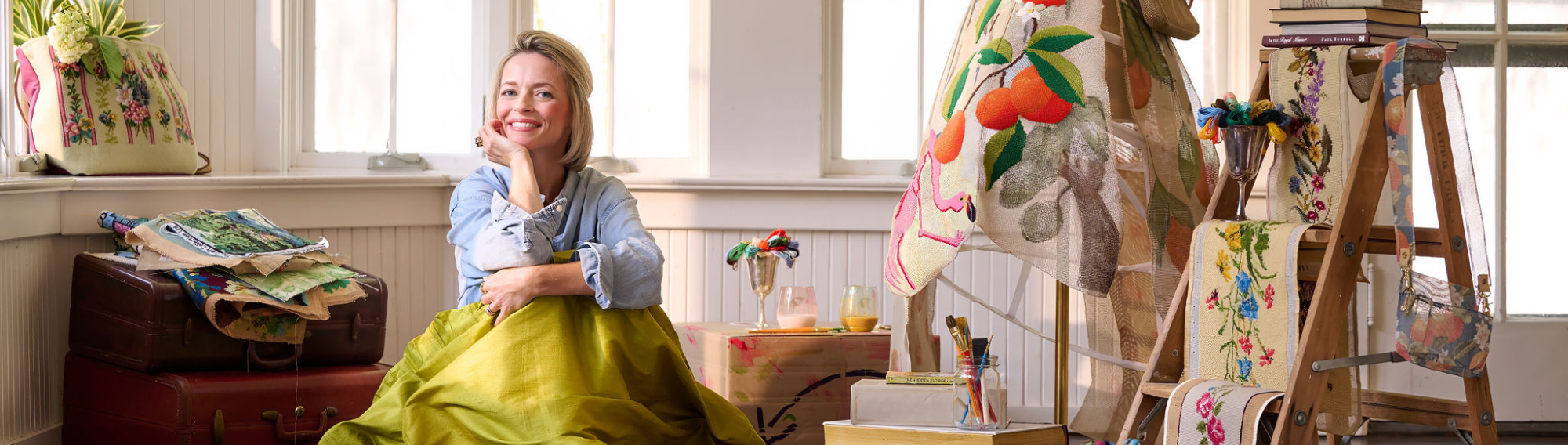
At Appletons, we’re endlessly inspired by the creativity of our stitching community and by the many different ways people are finding to bring this wonderful craft into their everyday lives. Heather Rae Atelier is doing exactly that, bringing traditional needlepoint into the world of fashion and creating beautiful, wearable pieces from both new and vintage stitching.
From handbags and envelope clutches to book clutches and accessories, each piece combines the craftsmanship and character of needlepoint with contemporary design. Yet the idea behind Heather Rae Atelier wasn’t part of a grand plan. In fact, it began with something much simpler: a problem that Heather wanted to solve.
A lifelong love of making
Heather’s connection with needlework began when she was very young, spending time with her grandmother in New England, who introduced her to sewing and other forms of needlework. Long before needlepoint came into the picture, Heather was making things herself, from doll clothes and bathing suits to knitted and crocheted pieces for her Cabbage Patch dolls. As she puts it, she has simply “had a long time with a needle in my hand.”
That instinct to make rather than buy has stayed with her. Heather has always enjoyed fashion and creating things for herself and her family, but she never imagined that it would eventually become something she did commercially. The turning point came when she began thinking about the finishing process and how frustrating it could be to complete a beautiful piece of needlepoint, only to have to send it away and potentially wait a very long time before being able to use it.
Then she saw something that sparked an idea.
“When Fendi released a pre-finished needlepoint item, I was like, wait a minute, that’s brilliant. I can sew. I could make that for myself.”
And that simple realisation was the beginning of a much bigger creative journey.
Finding a new destination for vintage needlepoint
Heather’s move into vintage needlepoint happened in much the same way: organically, as she encountered another problem that needed solving. She was trying to develop finished needlepoint pieces that people could stitch and use, but found herself struggling to source canvas. At the same time, she began noticing just how much vintage needlepoint was available, from online marketplaces to thrift stores and charity shops.
Rather than seeing those old pieces as something that had simply reached the end of their useful life, Heather saw an opportunity to give them a new destination.
“There was such an excessive amount of vintage tapestries,” she explains. “I was like, there’s not a needlepoint problem. There’s like a destination problem.”
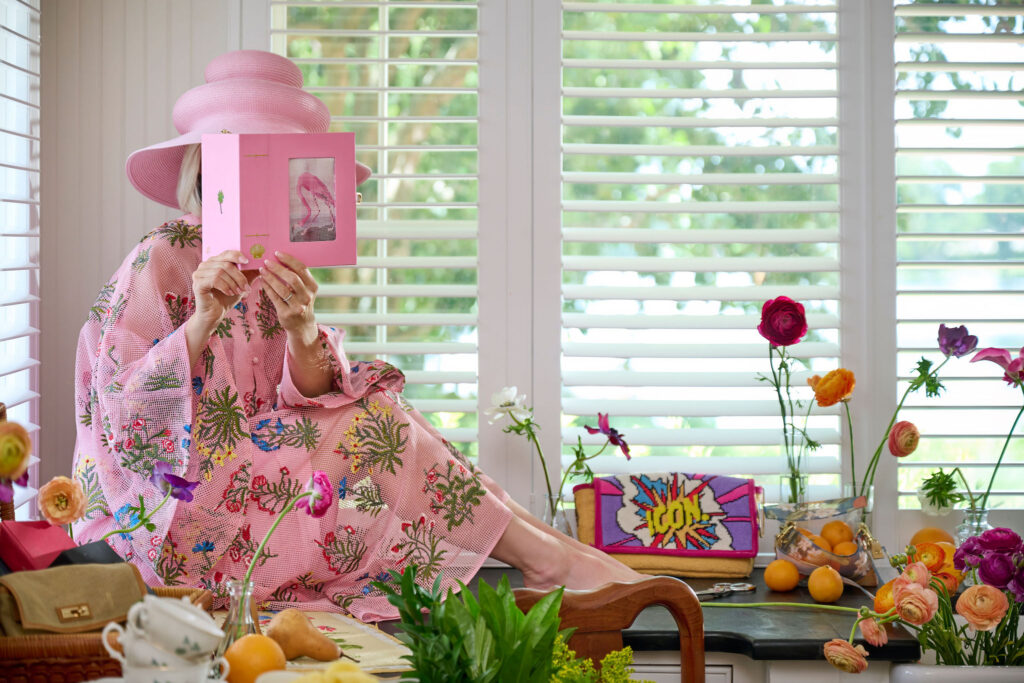
That idea has become an important part of Heather’s work. A tapestry that might otherwise spend another few decades folded away in a cupboard can instead become something that is used and enjoyed every day. A piece of stitching created in the 1950s or 60s can become a contemporary handbag, allowing the original craftsmanship to be appreciated in an entirely new way.
For Heather, this isn’t about changing needlepoint itself. The traditional stitches remain exactly that, traditional. What changes is where the finished work ends up.
“I don’t feel like I’m modernising needlepoint because the stitch is the same,” she says. “A woman from 1890, if she picked up any of these pieces, would be able to stitch it.”
Instead, Heather modernises the silhouette and the finish, combining the traditional beauty of needlepoint with contemporary handbag design. She particularly loves that unexpected contrast: a classic floral motif paired with a modern shape and luxurious leather details.
“It’s unexpected and interesting,” she says, and that sense of juxtaposition is at the heart of what makes her work so distinctive.
Letting the stitching lead the way
There is no one-size-fits-all approach to turning needlepoint into a finished accessory, and that is part of the creative challenge Heather enjoys most. Needlepoint comes in an enormous variety of shapes and sizes, so rather than starting with a fixed pattern, she starts by looking closely at the piece in front of her and asking what deserves to be highlighted.
“What’s the hero shot of the bag?” she asks. “Is there one centrepiece that you want? Is it an overall pattern?”
From there, the design develops through experimentation. Heather will fold and clip the needlepoint, playing with different shapes and proportions until she finds a silhouette that works with the design rather than competing with it. Her approach is essentially to work backwards from the stitching, asking herself how she can create a finished piece that allows the original needlepoint to shine.
It is also why one of the questions Heather is asked most often is, quite simply, “How can I turn this needlepoint into a purse?” There isn’t one pattern that will work for every piece, but Heather believes that many needlepoint designs can become something beautiful with a little imagination. A simple envelope clutch, for example, can be a wonderful starting point, particularly for someone making their first wearable piece.
The beauty of handmade
For anyone tempted to turn their own stitching into a handbag or accessory, Heather has some practical advice, and one of her most important tips is to think about the finishing process before you start stitching.
Leaving enough canvas around the design is essential if the piece is going to be machine sewn, with Heather recommending at least a couple of rows to allow for a seam allowance. She also strongly recommends blocking a newly stitched piece, as getting the needlepoint square before you begin makes the finishing process much easier.
But perhaps her most important advice is not technical at all. Don’t be afraid of making something that looks handmade.
Heather has worked with vintage tapestries that have never been blocked and have spent decades developing their own character and shape. While they may not be perfectly square, that history is part of what makes them special. “I think people sometimes get themselves in a rut, like, I want it to be perfect,” she says. Instead, she encourages stitchers to give themselves a little grace and enjoy the process.
“Did my grandma stitch that? Did your grandma stitch that? Did you stitch that? And did you sew it together?”
For Heather, those imperfections are not something to hide. They are part of the story, and part of the charm of owning something that has genuinely been made by hand.
“Perfection doesn’t come into handmade.”
Discovering Appletons
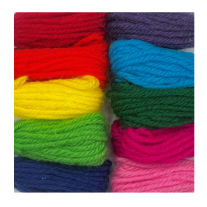
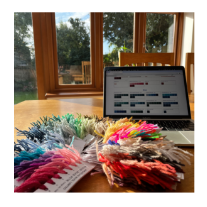
Heather was introduced to Appletons through H.M. Nabavian, a family business in New York and one of her suppliers. It was her first experience working with Appletons wool, but she quickly discovered something that was particularly valuable for the type of work she does: the consistency of the colour range.
When you are working with vintage needlepoint that may have been stitched 50 or even 100 years ago, being able to find a contemporary wool that closely matches an original colour opens up all sorts of creative possibilities.
“The fact that I can pull a tapestry from, you know, 50 years ago and probably match it with a wool that’s available in the shop today, that’s really cool,” Heather says.
Durability is equally important, particularly when the finished piece is going to become something as well used as a handbag. Heather’s first wearable needlepoint piece was stitched using silk and a silk-wool blend, which she loved working with, but she soon discovered that the material could pill when exposed to the everyday wear and friction that comes with carrying a bag.
Wool, by contrast, offers the durability she needs. Heather has also seen examples of needlepoint cushions stitched by previous generations that have survived beautifully over many decades, demonstrating just how long-lasting good wool and good craftsmanship can be.
“When you’re building a luxury item, you want the materials to speak for themselves,” she says. For Heather, Appletons’ heritage, quality and long-standing reputation make it a natural fit for her work.
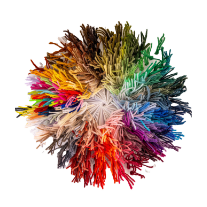
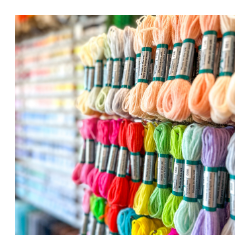
A world of colour
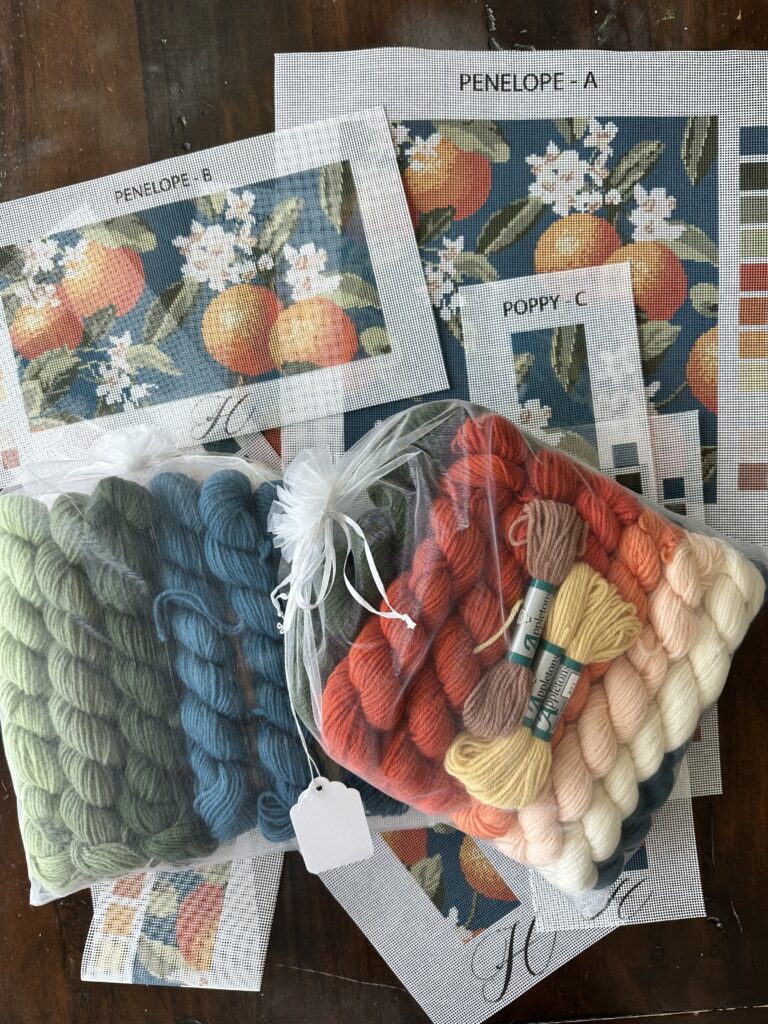
Colour plays a huge part in Heather’s work, and at the moment one of her favourite Appletons combinations can be found in her Orangerie canvases, where bright orange sits alongside deep blue and rich greens.
“It’s so rich and luxurious,” she says, describing the combination as almost jewel-toned and something that connects with her Southern roots.
She is equally drawn to the more unexpected possibilities within the Appletons colour range, particularly the neon shades. One recent handbag, created from an older tapestry believed to date from the 1960s or 70s, features hot pink and chartreuse lime green – a combination that feels surprisingly contemporary despite the age of the original stitching.
“I love the neon colours. Those are fun.”
It is another lovely example of the way Heather approaches vintage needlepoint: rather than trying to make it look old-fashioned, she celebrates the original character while allowing it to feel completely at home in the present day.
Why stitching is having a moment
So why does Heather think people are reconnecting with needlepoint now?
For her, the answer is partly about the pace of modern life. Needlepoint is slow and meditative, offering something increasingly rare: the opportunity to step away from a screen and spend time making something with your hands.
“I feel like the luxury is the ability to have the time to do it.”
In a world where so much is digital and disposable, there is something incredibly appealing about a craft that takes time and produces something tangible that can be kept, used and eventually passed on. Heather believes that sense of permanence and tradition is a big part of needlepoint’s renewed appeal.
“It just feels like needlepoint feels very permanent and it feels like tradition. And I think people love anything that gives them roots.”
She is also excited by the way needlepoint is beginning to embrace creativity from outside the traditional stitching world. Artists who have never traditionally worked in needlepoint are now bringing their designs to canvas, opening up new possibilities and helping the craft reach audiences who may not previously have considered themselves stitchers.
For Heather, that is an exciting evolution because it allows needlepoint to retain its heritage while continuing to grow creatively.
Starting your own stitching journey
For anyone inspired to try their hand at creating a needlepoint handbag, Heather’s advice is simple: start small, leave enough margin around your design, block your finished piece and don’t make your first project too ambitious.
An envelope clutch is a particularly good place to begin because the construction is relatively straightforward, and Heather has even developed a simple guide showing how one can be sewn together by hand using just two stitches.
Most importantly, she encourages new stitchers not to get too caught up in making everything perfect. The joy is in creating something yourself, and the finished piece should retain some of that handmade character.
“You know, it’s supposed to look handmade.”
What’s next for Heather Rae Atelier?
There is certainly no shortage of ideas. One of Heather’s newest projects is a brass belt buckle designed to hold a finished piece of needlepoint, allowing small stitched motifs to be transformed into something completely unexpected.
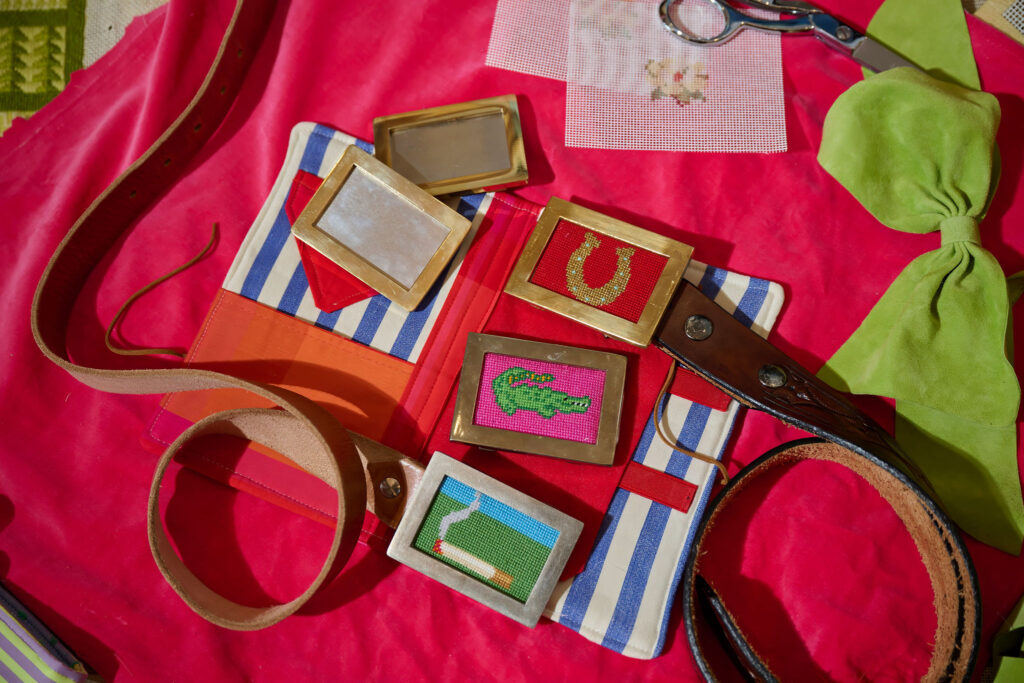
The idea came from the growing popularity of miniature needlepoint designs, many of which are being created as bag charms. Heather saw an opportunity to give these tiny pieces another purpose and worked with a metalsmith in Utah to develop a prototype before turning it into a finished product. The buckle allows the needlepoint to be removed and changed, meaning one accessory can take on a whole new look simply by switching the stitching.
There are also new book clutches in development, including an emerald green design with holiday plaid and a Christmas Carol-inspired canvas, alongside a black book clutch featuring a tiger and a bridal version designed around the idea of a “Love Story” or “Happily Ever After”. Heather is also working with artists from outside the needlepoint world to bring their work to canvas, something she describes as particularly exciting.
And it’s clear that this creative freedom is one of the things Heather enjoys most about what she does. She loves the process of developing an idea, experimenting with materials and collaborating with other makers, and is excited by the way the internet has made it possible to connect with creative people all over the world.
Stitching a new chapter
What makes Heather Rae Atelier so inspiring is that it doesn’t seek to reinvent needlepoint. Instead, it celebrates everything that makes the craft special. The tradition, the skill, the time, the colour and the craftsmanship – while finding new ways for those qualities to become part of modern life.
A vintage tapestry can become a handbag. A tiny stitched motif can become a belt buckle. A traditional design can become a contemporary fashion accessory, and something that might once have been tucked away can become something that is admired and enjoyed every day.
At the heart of it all is a belief that handmade things have a value that goes beyond the object itself. They carry the time spent creating them, the story behind the stitching and, often, a connection to the person who made them.
“I just think that is truly a desire,” Heather says of creating something by hand that can be enjoyed now and passed down in the future.
We couldn’t agree more.
We’re delighted that Appletons wool is part of Heather Rae Atelier’s creative journey and look forward to seeing where her imagination, love of colour and passion for needlepoint take her next.
 Back To Appletons Insights